- YEAR
- 2023
- ROLE
- Design Lead
- STATUS
- In progress
Digital rigour for a 100% QHSE record
Our client was an oil and gas company. To maintain a 100% QHSE record across all capital projects, the client and its contractors required improved QA/QC rigour, and a simplified, strengthened fabrication inspection process.
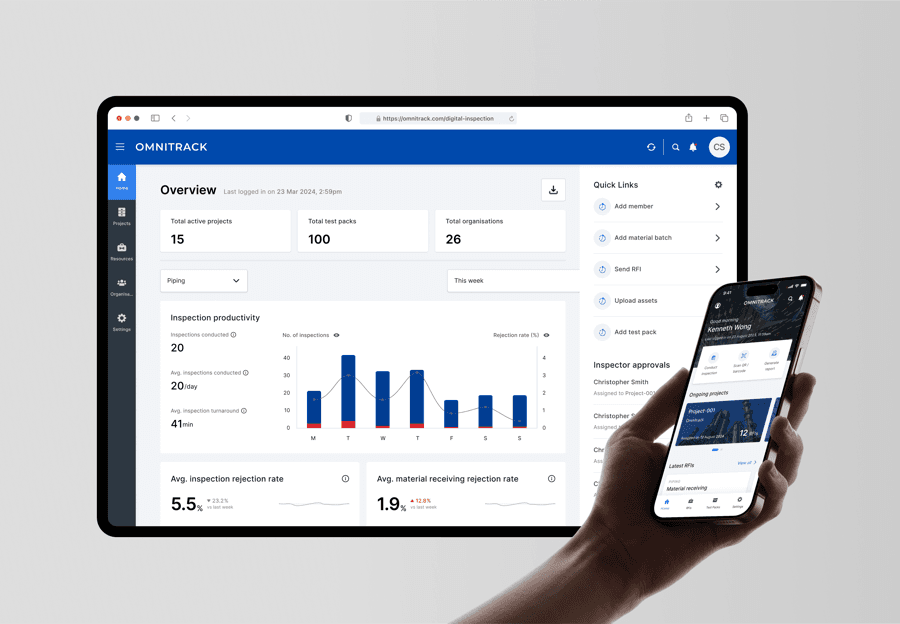
We incorporated best practices from more than 30 leading EPC companies, classification societies and commercial entities to develop an integrated digital solution: a web-based management platform and an inspection mobile app to streamline inspections, supported by non-digital initiatives such as change management plans, up-skilling and certification programmes.
- value realised over a two-year period
- USD 43M
- value realised over a two-year period
- efficiency improvements across inspection activities in 7 disciplines
- 30-50%
- efficiency improvements across inspection activities in 7 disciplines
- capital projects impacted across upstream and downstream oil and gas
- 15
- capital projects impacted across upstream and downstream oil and gas
Safety incidents, and a mandate to prevent the next one
Amid concerns over safety and reputation stemming from incidents at their contractors' fabrication yards, our client sought to bolster preventive measures. After an internal audit, they turned to us for assistance in fortifying their processes to prevent future mishaps.
Assigned to review the fabrication inspection processes with a diverse team of oil and gas specialists, inspectors and product owners, I was tasked with leveraging design research expertise to identify areas for improvement and explore opportunities for digitalisation in enhancing safety protocols and operational efficiency.
With too many disciplines to tackle in the yards at once, the team focused first on piping works — prioritised with the client as most critical, and the best window into how the yard works across the other disciplines.
HOW MIGHT WE
A management platform and a yard-ready mobile app
PRODUCT 1 — CENTRALISED MANAGEMENT PLATFORM
- 01
Efficient certification management
The platform centralises all asset and personnel certifications, allowing streamlined tagging and retrieval. Relevant qualifications and documentation stay easily accessible, reducing administrative overhead and enhancing compliance tracking.
- 02
Automated RFI management
The solution automates the scheduling and management of Requests for Inspection, prioritising critical inspection paths to minimise hold-point durations, with clear visibility into inspection progress and inputs for timely resolution of issues.
- 03
Comprehensive reporting
Tailored, detailed inspection reports for each stage of the process support accurate documentation, aligned with the operational and regulatory standards of contractors and the parent company, and customisable to integrate with the yards' existing reporting procedures.
PRODUCT 2 — INSPECTION MOBILE APP
- 01
Accessible RFI retrieval
Quick retrieval of relevant RFIs and inspection data directly from the field, so inspectors have immediate access to the information they need — reducing delays and improving inspection accuracy.
- 02
Streamlined inspection reporting
Inspectors report findings conveniently, with essential resources like Welding Procedure Specifications and material certificates at their fingertips. AI-enhanced validation helps prevent duplicated inputs, protecting the integrity of inspection data.
- 03
Efficient report handoff
Simplified transfer of inspection reports to subsequent inspectors promotes continuity and reduces the risk of errors or omissions across shifts.
PRODUCT IMAGERY
Precision and focus, sprint by sprint
- 01
Conducting initial research
Understanding the problem space and what to design.
- 02
Project scoping
Organising the design and development governance and roadmap.
- 03
Design sprints
Understanding and defining specific technicalities and requirements in order to design.
- 04
Overall user testing and refinement
Testing and refinement of designs sprint by sprint and during key milestones.
- 05
Post-launch planning
Defining key monitoring and success metrics, and change management plans.
The full story behind each step is being written up, in the same expandable format as the cash loan case study.
What changed across the inspection journey
Illustrative process improvements across the inspection journey, through automation, centralisation, transparency, documentation and technology integration.
FROMRandom inspections, inaccurate and delayed progress
TOAutomated inspection request scheduling by critical path, with stringent inspection stage gates
FROMManual data entry, non-standard forms, lack of data validation
TODigital reporting with automated forms, centralised management, AI-backed authentication
FROMLack of transparency, siloed data management
TOCloud-based system with 2FA, integrated platforms, on-site surveillance
FROMLoose access control, poor welder and inspector assignment
TOStrict access protocols, pre-qualification checks, intelligent rostering, complete documentation
FROMPoor welding performance monitoring, unclear standards
TORegular equipment checks, data analysis, training programmes, automatic standards assignment
FROMManual tagging of spools and progress
TORFID/QR tagging with easy identification via the app
Navigating complex challenges through strategic solutions
- 01
Enhancing domain expertise for effective design
The team initially faced significant challenges understanding the technical nuances of the fabrication domain. Working closely with domain specialists and client stakeholders, we engaged in iterative questioning, co-designing and rigorous testing to capture and build the right features. Learning new insights weekly, I worked closely with the product owner to adapt sprint requirements dynamically, and involving developers in interviews and testing sessions deepened their understanding of what they were building.
- 02
Rethinking complex traditional processes for digital experiences
Instead of literally digitising the offline forms, developing an intuitive and comprehensive solution required rethinking the information entry process itself. That different way of thinking demanded effective communication with management to align on the new vision and avoid mismatched expectations on features and timeline. Serving diverse user groups across fabrication yards also demanded clear persona definitions and detailed documentation.
- 03
Strategising access to end users
Gaining access to yard users was challenging due to the reluctance of contractor organisations to participate. We leveraged key management stakeholders with domain knowledge and focused on building relationships with contractors to facilitate better engagement — gathering valuable insights despite the initial barriers.
- 04
Navigating organisational complexity
The client's complex organisational structure — frequent structural changes and a change of project sponsor — posed significant challenges. Regular check-ins with all stakeholders were essential to navigate transitions and stay aligned, and the siloed nature of departmental work required proactive communication to align on features and avoid duplicated effort.
- 05
Integrating with existing operational processes
While the MVP aimed to streamline digital processes, it still needed to integrate with the client's existing operational procedures, including paper-based documentation for final confirmation. Proper integration into the overall service journey was key to users feeling comfortable with the tool; longer-term operational improvements were scoped into subsequent phases.